Crystal Ski

Crystal Ski

Innovation projects

Digital Experience

What

We were challenged to create a digital experience that would allow consumers to interact with the latest Crystal Ski brand campaign. The remit was broaden so that the digital experience would sit at the heart of the campaign and various channel activities could then align around it for campaign cohesion.

How

Using consumer and historical ski research, we created a fun way for consumers to engage with skiwear through the ages. We created a platform that allowed online consumers to upload a photo and create a ski outfit from the 60s, 70s, 80s and 90s – now that’s what we call fun!

We created:

  • Interactive content
  • Earned media campaigns
  • Social integration

Results

The net result of the work with Crystal Ski is a year on year increase in organic traffic of 162%. Social engagement has improved significantly which all adds up to an improvement in sales from the target audiences of circa 37%.

We can work with your company to deliver a digital experience for your customers.

Get in touch to discuss your company’s requirements and we will work together to find the best solution.

Hayes & Jarvis

Hayes & Jarvis

Integrated app campaign

New York, New York

What

Hayes & Jarvis asked us to develop an integrated campaign to that would serve to create awareness and drive consideration of their standalone New York city breaks and provide a digital experience for travellers booked and destined for New York.

The real New York. We all think we know it. Film and TV have given us a glimpse of this amazing city, but that’s just fiction. The modern traveller is looking for experiences, something different, something they haven’t done before. So we decided to show off the best of New York from the people that live and breath it. 

Most consumers go to New York to shop, this was something we couldn’t ignore. So based on this key insight we facilitated a unique experience by creating bespoke shopping routes as the digital interaction at the heart of our campaign.

how

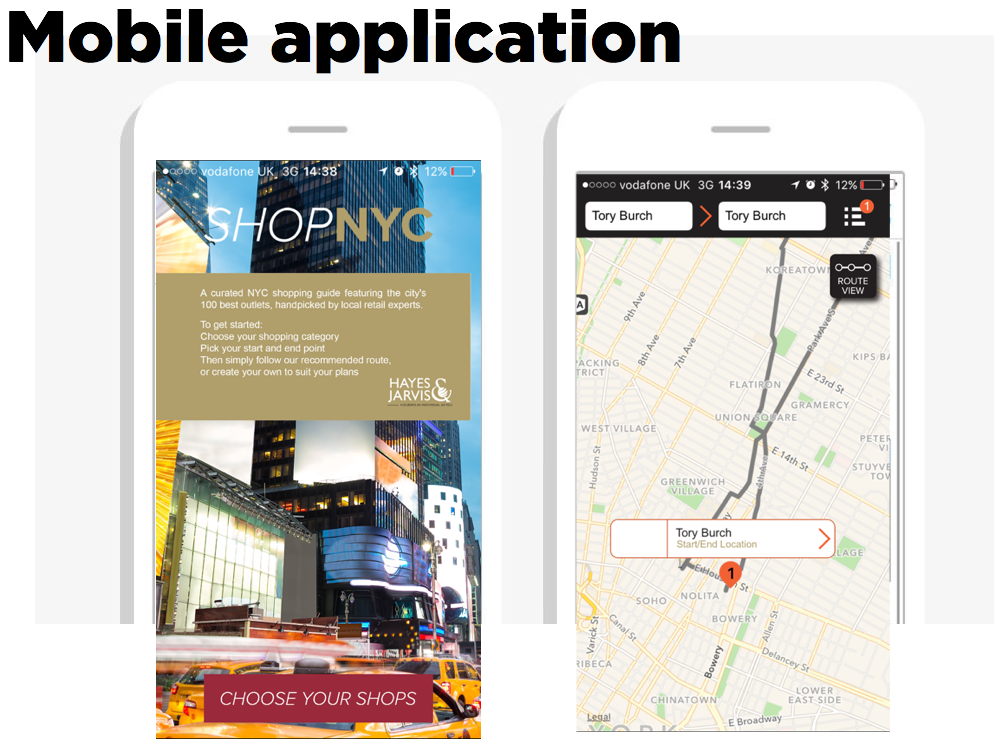
We developed a mobile app featuring the routes, such as “Vintage New York” and “Classic department stores”, delivered through a map-based interface. Routes were heavily adaptive with user-defined start and end points to fit in with their itinerary. This was important because we wanted the user to feel it was bespoke. Data was available in offline mode to save on roaming charges when wifi wasn’t available.

Onsite content told the story of each route and the experts backgrounds. This was important as we wanted users to feel the experience was authentic – a key Hayes & Jarvis brand value.

We delivered the app in conjunction with promotion on social and a PR campaign to drive customers to access the site and use the app.

Results

+0%
Increase in New York city break bookings
+0%
Website traffic for New York and USA pages

App of the Week

As voted by the Sun Newspaper

dvo can deliver everything from designing a creative app to grow sales to full service marketing.

Get in touch to discuss your company’s requirements and we will work together to find the best solution.

Codetoday

codetoday

Codetoday

Building growth

Coding for Kids

Challenge

To grow a local kids’ coding provider into London’s premier coding school, and then Covid came along!

The growth goals remained but the pandemic necessitated a move to a purely online business model.

Approach

Taking a long-term view, the dvo team embedded into codetoday to create an in-house marketing department.

This meant working closely with the founder to bring his vision to life, handling the strategic as well as the day-to-day and managing projects throughout the engagement.

Projects included:

  • A full rebrand
  • New website development with full Ecoomerce capabilities

Results

As a result of dvo’s support, codetoday’s monthly revenue has tripled, the brand has been completely updated, a new e-commerce website has been launched.

The most striking results however occurred during 2020 with a transition from face-to-face to a purely online education business. From Q2 2020 and ZERO online students codetoday now teach over 200 students per month and this is growing at 10-15% MoM.

This growth has continued into 2022 with the project culminating in the hiring of permannet marketing staff and the transition to a subscription model.

dvo continue to work with the codetoday founder in a strategic advisory role.


dvo embeds into your team. Taking ownership of marketing and delivering on your goals.

Get in touch to discuss your company’s requirements and we will work together to find the best solution.

Countrywide

Countrywide

Strategic projects

New German Chair

Process

Lorem ipsum dolor sit amet, consectetur adipisicing elit, sed do eiusmod tempor incididunt ut labore et dolore magna aliqua. Ut enim ad minim veniam, quis nostrud exercitation ullamco laboris nisi ut aliquip ex ea commodo consequat. Duis aute irure dolor in reprehenderit in voluptate velit esse cillum dolore eu fugiat nulla pariatur. Excepteur sint occaecat cupidatat non proident, sunt in culpa qui officia deserunt mollit anim id est laborum. Sed ut perspiciatis.

Design

Lorem ipsum dolor sit amet, consectetur adipisicing elit, sed do eiusmod tempor incididunt ut labore et dolore magna aliqua. Ut enim ad minim veniam, quis nostrud exercitation ullamco laboris nisi ut aliquip ex ea commodo consequat. Duis aute irure dolor in reprehenderit in voluptate velit esse cillum dolore eu fugiat nulla pariatur. Excepteur sint occaecat cupidatat non proident, sunt in culpa qui officia deserunt mollit anim id est laborum. Sed ut perspiciatis.

Process

01.

Lorem ipsum dolor sit amet, consectetur adipisicing elit, sed do eiusmod tempor incididunt ut labore et dolore magna aliqua. Ut enim ad minim veniam, quis nostrud exercitation ullamco laboris nisi ut aliquip ex ea commodo consequat.

02.

Lorem ipsum dolor sit amet, consectetur adipisicing elit, sed do eiusmod tempor incididunt ut labore et dolore magna aliqua. Ut enim ad minim veniam, quis nostrud exercitation ullamco laboris nisi ut aliquip ex ea commodo consequat.

03.

Lorem ipsum dolor sit amet, consectetur adipisicing elit, sed do eiusmod tempor incididunt ut labore et dolore magna aliqua. Ut enim ad minim veniam, quis nostrud exercitation ullamco laboris nisi ut aliquip ex ea commodo consequat.

04.

Lorem ipsum dolor sit amet, consectetur adipisicing elit, sed do eiusmod tempor incididunt ut labore et dolore magna aliqua. Ut enim ad minim veniam, quis nostrud exercitation ullamco laboris nisi ut aliquip ex ea commodo consequat.

“Where do new ideas come from? The answer is simple: differences. Creativity comes from unlikely juxtapositions.”

Importance Of The Custom Company Logo Design

Lorem ipsum dolor sit amet, consectetur adipisicing elit, sed eiusmod tempor incididunt ut labore et dolore magna aliqua.

Content strategy, start to finish.

This week we take on content strategy in all it’s glory.

Always-on social content strategy is a core discipline that is squarely on both brand and agency agendas, and rightly so in our humble opinion. But most of the content marketing conversation we see focuses on the tactical delivery and technology surrounding content, so we thought we’d put forward how we develop a content strategy, or any other strategy for that matter. It’s always a vitally important step but is so often overlooked or fails to align with the wider brand marketing strategy and that’s very risky, whether you’re a start-up or seasoned brand.

We’re staunch advocates of a rigourous approach to everything we do, especially when developing strategy and we want you to be too. Why? Because you’re probably being bombarded everyday with the next tool or simple process that promises little effort and work for massive results and I’m here to tell you that this simply isn’t true. None of the really successful brands, new or old, got where they are by cutting every corner imaginable, that’s not how the world works.

In the post we’ll cover everything, including:

  • Setting objectives
  • Research
  • Uncovering insights to inform your strategy
  • Segmentation of data
  • Persona building
  • Customer journey mapping
  • Strategy
  • Creative and how to think about a long idea for content
  • Co-creation and UGC
  • How this is delivered and structuring a content calendar
  • Media planning to inform distribution
  • Activation, management and refinement

It’s a lot to get through so grab a cuppa and hold on to your hats!

Setting objectives

Before doing anything, it’s really important to have some goals in mind. Building a customer-centric marketing strategy with content at its heart is brilliant and highly effective. It’s going to give you the edge over your competition if they’re not, because connected consumers are more likely to buy things from you if you put the right content in front of them at the right time.

So well done you on reading this as you’re obviously looking to develop your content strategy. If you’re not then read on anyway, we might just convince you to take the plunge.

However, as with all marketing, you need to set aspirational but realistic goals. If you don’t, then how do you know if what you’re doing is working or, sometimes more importantly, not working, so you can fix it. So many times we see brands pumping large budgets into projects with no clear objectives or metrics in place.

Strategy, by definition, is “a plan of action designed to achieve a long-term or overall aim.”

So start big, think increasing sales, changing perceptions, building awareness in new markets, increasing market share.

Once you’ve got these aims in mind, you can start to layer performance indicators underneath, that measure individual tactics in the context of the overall aim, commonly called KPIs (Key Performance Indicators). We can’t stress enough how hugely important it is to have these in place, without them you simply have no idea whether your content strategy is working. The KPIs you create will, to some extent, be influenced by what you decide to do within your strategy and could be a variety of things dependent on what you’re looking to achieve.

DO NOT CONFUSE GOALS WITH KPIs! THIS IS A TRAP MANY FALL INTO AND WONDER WHY THEIR FACEBOOK LIKES KPI DOESN’T DIRECTLY EQUATE TO MORE SALES.


Research

Everyone goes on about how important research is but I’m yet to read a good post that actually tells you anything constructive to help you get off the ground. There are basically two routes to go down, depending on how well structured your brand is. If you’re well on your way to having a good set of guidelines for how your brand communicates itself, including behaviours, values, personality, tone of voice, in some shape or form, awesome. If you’re not and you just have a logo, some colours and fonts, then it’s worth taking some time to build up your brand’s personality a little. Crystallising the essence of your brand will give you clear guidance on the style and tone of your content.

Our research methodology covers data and qualitative research in four areas:

  • Brand
  • Competitors
  • Landscape
  • Consumer

We dial up and down in each area how much data we have (limited by availability) and the qualitative research we undertake.

Data sources:

  • Internal customer and prospect database
  • Social listening
  • Geo demographic data
  • Website analytics

Qualitative research:

  • Surveys
  • Focus groups
  • Good old desk based Internet trawling of research papers
  • Trend libraries, Mintel, Canvas8 for example
  • Our planning teams experience and internal ongoing research

We then scrutinise the research in granular detail. So whether that’s looking for relevant elements, segmenting data to find significance, overlaying datasets, buying behaviour or macro trends and future spotting, it’s all tightly analysed. Insights are then derived through the process. Importantly, we then scrutinise again, as we don’t take anything at face value and delving deeper and deeper often uncovers insights that others have failed to spot. This alone can give you a huge advantage.

Uncovering insights

I could wax lyrical for ages on this but I’ll try and keep it short. Insights are simply unexpected facts that seem to contradict actual assumed perceptions. This sort of thing is very well described in books like “Thinking, Fast and Slow” (Daniel Kahneman, Penguin). Generally, we form opinions on things simply because our brains are a bit lazy. So aim to uncover insights that challenge perceptions because they will reap big rewards.

A good example of this is playing out right now in financial services. Women account for a huge potential market with un-invested funds, control of family budgets and generally more say in family economics and purchasing decisions. This flies in the face of convention that suggests the man who goes out to work controls the money. Rubbish. You can see in loads of financial services advertising and content that it’s squarely aimed at women.

Hold onto these insights they’re important for the later stages and they will give your content strategy a competitive edge.

Data segmentation

It’s time to chop up your data into more manageable, useful chunks. Your aim is to group together people who have similar characteristics, whether you choose a simple path such as age gender, location or a more sophisticated route such as behaviours, product choices and lifetime value. Or a combination of both perhaps.

Customer personas

Once you’ve got some segments you can start to build some personas for each one. Don’t go mad, you only need a few.

A persona should look something like this example we created for work in the property sector:
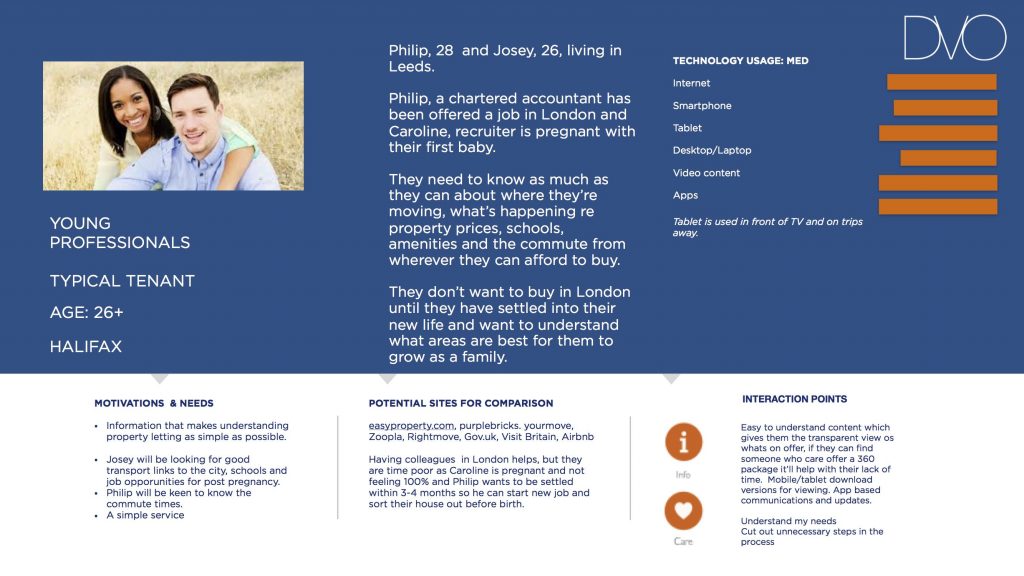
This helps inform your creative, your timings and your distribution choices.

Consumer journey mapping

Once you’ve established personas that either look like your customer segments or the result of your research, if you haven’t got a large customer database, then it’s time to think about journeys. Mapping the consumer journey is one of the single most important things you will down creating a content strategy, or any marketing strategy for that matter. It puts the consumer at the heart of your organisation and allows you to build your entire experience around them.

Generally we take a 5 stage approach, covering:

Creation of customer stages

These are the behavioural stages a customer and potential customer go through to ultimately buy your product or service. Depending on your sector these can happen quickly or over a long period of time, regardless, they will go through different stages. Some of these include; discovery, research, consideration, purchase, advocate.

Understanding goals and needs

It’s important to keep in mind that the journey map is about the consumers goals not yours. We identify what it is that the consumer needs that’s going to help them achieve their goal at any given stage. This helps us identify the touch points where we can meet these needs. If we can achieve the consumers goal we can move them to the next stage of the journey.

Identifying the touch points

Through the process you should now be building a picture of where you can interact with your consumer. This could be online, offline, in person there are now many places to interact and in many different ways. What you’re looking to identify are the important ones, the places where you can interact that will have the desired affect.

Leveraging data

The basis for any good consumer journey map is data, whether that’s data explicitly derived from your own database, via third parties or through anecdotal research. The challenge faced by most brands however is that their channel ecosystem wasn’t created based on a specific journey, it’s just sprung up because the brand felt they should. We’ve met many brands operating across multiple channels with little actual understanding of their customer. Very often most of the data is from outside sources in this scenario and a certain amount of testing is required to find a balance across the customer journey before thinking about optimising it.

Identifying gaps

The customer journey map very quickly shows us how siloed organisations are, identifying where gaps exist and where needs aren’t being met. This is a great exercise that helps multiple teams align around the customer, but it’s not without it’s pain points.

The journey map should be viewed as a living document that can change as we learn more about our customers for this very reason. The gaps highlight where you are weak and where you should focus efforts.

Strategy

We always aim to craft a simple strategy into something you can articulate in one sentence. This sounds simple but is actually pretty difficult, but it is worth it. With the strategy in mind, you can shape all your activity in the same direction. Your strategy is designed to give you the tools to hit your goals and it will bring into line everything else you do.

There are all sorts of different frameworks you can use but the fundamentals are virtually always the same.

Some of the frameworks include:

SOSTAC, situation analysis, objectives, strategy, tactics, actions, control.

This is what we follow at DVO and we’ve laid this article out following the stages in SOSTAC.

You can read more about SOSTAC
here
and a host of models that have stood the test of time, here.

Creative and how to think about a long idea for content

You may already have your brand creative and a big idea that forms the basis of your communications. If so, awesome. Your job is going to be quite a bit easier as your task is now more about adapting that story and communicating it through always-on channels, such as your blog and social media.

If you don’t, it’s time to think about an idea or a story that you can tell.

At this stage it’s great discipline to think about developing a creative brief. This is where the fruits of your planning and strategy can guide the creative process, putting in place the boundaries and framework within which thoughtful ideas can flow. We wrote a post recently on the agency briefing process so we won’t go into that again here, but it’s worth reading.

Agency briefing process

This is where we as agencies should excel. The planning and strategic process is designed to ensure that the ideas, technology and activation have the best chance to succeed providing the insights that create a real competitive advantage when telling brand stories.

In traditional advertising the narrative is often the starting point to pick out key messages that then manifest as a visual or copy in adverts. With content marketing, it’s the other way around. What are the messages you want to communicate and how can these be turned into a narrative? How can that then form the themes and elements within your content to give you enough room to talk around the subject over the long term.

There are many ways to achieve this. We’re big advocates of the golden circle method, especially given the attitudes of connected consumers.

Rather that the what > how > why approach, the story is told the other way around why > how > what. This is a successful tactic that companies like Apple use as it builds a much stronger affinity with their target market. We know that people buy into businesses with a strong philosophy and sense of purpose and this tactic aligns brand and consumer much more closely.

The consumer journey map we created earlier is where we blend creative and data. Data helps us to understand where and when we should communicate but it’s the creative that makes the difference. Only the best creative will cut through the noise and give us the competitive edge. It’s this blend that is a real area of competitive advantage for brands willing to push themselves and their agency partners.

Co-creation and UGC

Something that is increasingly important for brands is how they co-create with both the influencers and their wider brand audience. Customers as advocates, UGC, whatever your preferred term one thing is for sure that bringing external voices into your story not only amplifies its reach but enhances its authenticity. Some of the most successful integrated content campaigns weave external content in from the start. Whether they use a simple device to get people to share pictures or stores such as a branded hashtag or employ more sophisticated tools such as Tint to source UGC content and repurpose this on websites, advertising and in social media. All work on the simple fact that people trust other people more than they trust your brand. It’s word of mouth at scale and thinking about how your concept and strategy can incorporate it can help a good campaign become a great campaign.

How this is delivered and structuring a content calendar

A content calendar is an essential and really useful tool. It needn’t be complicated and can help you shape the story and act to bring cohesion across all the elements. Building one is pretty easy and if you need help there are loads of free tools and examples online.

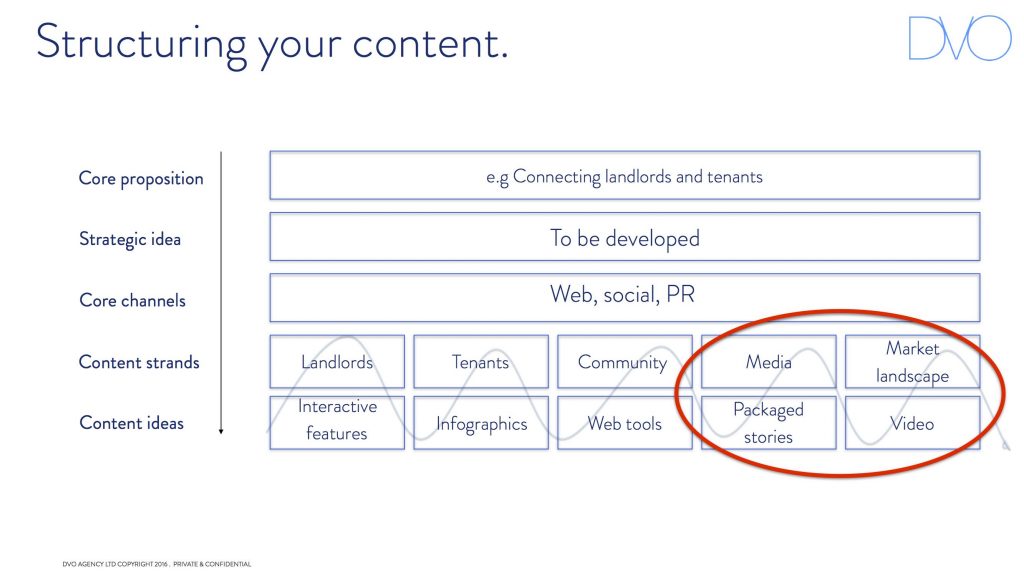
It’s worth thinking about a content framework that would look something like this example from work in the property space we have undertaken which prioritised video and media friendly content:
Media planning to inform distribution

Media planning is one of the most overlooked areas of content, so much so that it’s become a cliché to even say but here goes. Your content can be the most relevant, exciting and engaging content in the world, but if nobody reads it, it is entirely useless.

Depending on what channels you’ve selected, based around the research you’ve done regarding your customer’s journey, you should by this point be starting to categorise your content based on what it’s designed to achieve. For example, is it about awareness and getting people engaged with your brand, is it about consideration, driving home a message with longer more informative content, is it about conversion creating a compelling reason to buy?

Different types of content suit different channels. Putting the wrong content out through an inappropriate channel can render it dead in the water, no matter how brilliant the content actually is.

Activation, management and refinement

Time to put your money where your mouth is. You should now have all the elements in place to successfully implement your content strategy. You should have a clear picture of your consumer, where they are, and what their needs are. You should have content that is structured and a distribution plan to put the right content in the most effective place. Importantly, you should understand what data you want to capture, what you’re going to measure and how this can then be analysed to improve what you are doing.

We hear so many stories that talk about just diving in with a thin scraping of research, especially where start-ups are concerned (seriously, SO MANY TIMES IT’S SCARY). I think this is a huge and potential expensive risk. Unless you really understand what and why you are doing things, it’s the fastest way to see zero results and lose money. Good work and great results take a bit of effort. I’m writing this blog in the full knowledge that, hopefully, some readers will follow this and it will help, but in reality for many it’s not that easy and for good reasons. If it was, then we’d all have traffic, customers and sales coming out of our ears and wouldn’t need to worry.

Now it’s time to think about how you are going to test your content, track your KPIs and bench mark what does and doesn’t work. You can apply a simple a/b test philosophy to your content and also test across the customer journey to see whether your content is moving people to the next natural stage. Be mindful though consumers don’t observe a linear funnel so keep this in mind that people will likely come in and out of your channel ecosystem at points of their choosing. Be flexible and this won’t drive you mad.

If you’d like to talk to us about how we can help you through the development of a content strategy we’d love to hear from you. It’s complicated and there aren’t any shortcuts. But get it right and you will foster loyal customers and hit the heights that have often seemed out of reach. Pick up the phone, give us a call, we’ve got nice biscuits and we can help.

Contact us

GDPR, a missed opportunity.

GDPR, four letters designed to strike fear into the hearts of IT and marketing professionals.

What a sorry state we’ve found ourselves in, scrabbling to opt-in data like rats on a sinking ship. It could all have been so different.

In this week’s blog I’ll be waxing lyrical on missed opportunities, the dubious nature of pre-GDPR email capture tactics and some campaigns I’d have liked to have seen beyond the drab “We’ll miss you when you’re gone” emails cluttering my inbox.

What is GDPR?

Well if you don’t know by now take a gander through your inbox, or more likely spam box, you’ll have quite a few emails announcing a change in Data Protection Regulations. In a nutshell the law surrounding how data is captured, processed, used and destroyed is changing. The new law is called GDPR (General Data Protection Regulation). Essentially the consumer is getting beefed up powers to control their data and the other side of the fence needs to play ball. Or you’ll be fined, a lot.

Why are things like this in the first place?

To answer that I would highlight practices such as:

  • Linkedin email harvesting
  • Facebook group email harvesting
  • Viral competitions with dubious opt-in practices
  • Virtually any “growth hacks” to get email fast

It’s a long list, even those operating above board haven’t been using double opt-in or gaining the correct consent despite knowing of the regulation changes for some time.

What’s the answer?

Sadly it’s not a win for the Brexit camp. The UK is adopting the regulations despite our departure from the EU. Seems like a missed opportunity to me? Liam Fox proudly promoting Britain as the email frontier town where anything goes, consent, opt-ins well they’re just fancy words from back east.

Actually the answer is that we should have been gaining consent a long time ago but that got in the way of quick list building and fast lead gen. So we didn’t and now we’re looking at losing 80-90% of our marketing databases. Which is somewhat of a bummer. There’s a mad scramble going on to get consent, hence the tremendous amount of emails arriving in inboxes daily. After the 25th May businesses in the EU or emailing EU citizens must comply with the legislation or risk a fine.

*I am not a lawyer, so don’t take anything I say about GDPR  as gospel. Speak to your lawyer if you have questions, he’ll probably have been asked thousands of times and will roll off what you need to do, whilst searching the web for a new boat that all the fees will be netting him!

Hold on isn’t there a way round this?

Well it’s a tricky one. In the office we speculated about contacting Julian Assange to see if he fancied setting up an email provider from inside the Ecadorian embassy, in the hope that we could claim asylum for the data on the grounds that it wouldn’t receive a fair trial, because quite frankly we didn’t have a clue where it had come from.

We’re creative marketing people, why so many bland campaigns?

Weatherspoons seemed to get more exposure announcing they were deleting all their customer data. I think they may have secretly sold it to Ukip!*

*Pure speculation designed for limited comic effect.

For the rest it seems that to the letter everyone has played on the, look at all the cool stuff we send out you’ll miss us band wagon. I’d have liked to have seen something a little more creative, how about:

Subject:

Do you believe in a better future

Content:

We’ve got your email address. We think you opted-in to something but it all honesty we aren’t that sure. Anyhoo, let’s not dwell on such boring symantics. Assuming you have a legitimate interest in {Insert something here] then we’d like to keep sending you stuff in the hope one day you might buy something. When that day comes we will rejoice and we will remind you of this moment and how things could have been so different.

So if you believe there’s a better future click here:

Button: I believe

Or how about:

Subject:

Get your [Insert cuddly animal here] soft toy Free

Content:

If you opt-in to our list you’l get a soft toy. If you don’t it means you hate animals.

Button 1: Claim Soft Toy

Button 2: I hate animals

Or a topical one

Subject:

It’s down to you

Content:

The data we hold is being processed in North Korea. We have been given a directive by Kim himself. He has told us to use two buttons to get your consent. A red button and a green button. Green opts you in, red, well red is Kim’s red button, press it at your peril.

You get the picture!!

What will a post May 25th world look like?

Exactly the same as it did before so let’s not panic too much. Response rates on most email lists are crap anyway. Opt people in properly, update your privacy and focus on building a truly engaged list of people who want your content. If that’s proving tricky make better content. If you struggle to do that it’s unlikely you really understand your brand and your customers, go back to basics look at your brand, does your message and personality actually engage the market you are communicating with, does it meet a need, are you talking to the right market?

I think the biggest thing that will come out of GDPR is a need to focus on marketing basics, brand building, understanding the customer and moving beyond tactical channel hacks.

Surely that’s a good thing?

I’ve been silent for a while but no more, keep your eyes open for more ranting from the self styled “Mark Ritson for the digital Age”. Or sign-up for the DVO newsletter and other relevantish communication, we don’t send it often but when we do. Well, you’ll see!

(Notice the nice checkbox asking for consent on the form on this page, GDPR win!!)

DVO agency does not condone anything written by Ben Dickens in this blog, in fact we actively discourage him from writing it, but hey, he knows the passwords.

The user generated content marketing phenomenon

You’ve probably noticed lots of noise about content marketing and specifically, user generated content marketing (UGC) at the moment. But UGC isn’t a new thing, customer review sites have been around for decades and certain ones are huge players on the digital field.

Often, when brands consider incorporating user generated content marketing into the business, it’s straight forward customer reviews that spring to mind. For marketers this means striving to achieve only positive reviews, which is why many, even very experienced and ‘switched-on’ marketers are often fearful of embracing UGC in their marketing mix.

But reviews really are just the tip of the iceberg when it comes to user generated content marketing and a strategy that effectively leverages UGC is a very powerful thing indeed.

An intrinsic element of a well-crafted content marketing approach, UGC can be the fuel that drives wider engagement, builds trust and powers marketing channels well beyond the lifespan of a campaign, even a really good integrated one.

In this article, we will explore:

·      Exactly what user generated content marketing is?

·      A strategic overview of UGC.

·      Putting UGC to work, practical steps.

What is user generated content marketing?

Content Marketing is arguably the most important element in customer communications in the world of marketing today. This is in part due to the huge explosion of technology seen recently and has intrinsically changed the way that customer consume and engage with content.

DVO created a white paper on UGC marketing with industry expert Gerhard Malojer, his definition of User Generated Content is:

“User Generated Content Marketing is authentic content generated by users in connection to a brand, encouraged by an inspiring and empowering call-to-action framework from that brand, with the aim of raising brand interest and generating sales”

For further reading download the whitepaper.


A strategic overview of user generated content marketing.

UGC, used effectively as part of a holistic omni-channel marketing strategy, can be a very powerful tool. As the power over the actual content ultimately lies with the consumer, this can lead many brands to be fearful of UGC. But with the right strategy and framework in place, UGC can be hugely beneficial to a brand and makes content marketing so much more seamless.

Still unsure? Here’s some facts and figures that might help change your mind:

·      Advertising based on UGC can result in a 400% increase in click through rates

·      UGC can increase web conversions by 26%

·      UGC on a site can results in a 20% increase in returning visitors and time customers spent on the site itself can increase by up to 90%

Much of the User Generated Content that we all experience day to day is that of online reviews. Whether it’s suing it to research your next holiday, or being asked for it after purchasing something from an online retailer, customer reviews are extremely valuable. From everything from products to services, packaging, and the ultimate delivery, every step of the customer journey through their purchasing decisions is open to review.

But why are brands and service providers so keen to allow themselves to be critiqued inn such a way? Well….

·      When making a purchasing decision, 93% of customers say they find review helpful

·      Having customer reviews on your site can increase conversion by 74%

·      64% of customers will actively search for online customer reviews

So, what makes UGC so massively powerful? Well, the very simple answer is, trust.

Since human society evolved, we have shared stories and experiences. It’s what builds communities and holds them together, sharing the human experience. Ultimately, that is what UGC is about, sharing our experiences. It’s just that the technology has changed the way we do this.

Word of mouth is the most powerful marketing discipline available to any business. It’s the one channel that will gain you the most return, but it’s also the hardest one to deliver, as you really don’t have any control over it. Why is it so powerful? Well, people tend to trust other people. A brand might share a piece of messaging, which is largely ignored. But if a person shares that same message, their peers, friends, family, colleagues and even strangers are more likely to not only listen, but also trust it.

·      70% of people will trust peer reviews and customer recommendations more than the same brand value messaging direct from a business

·      Social networking (50%), peer reviews (68%) and conversations with friends (74%), which are all forms of UGC, are trusted for product information for than TV (34%), radio (37%) and newspapers (44%)

So, if you want to gain consumer trust, a major contributing factor in not only gaining new customers but retaining existing ones, then you need to get people outside your business creating and sharing content about your brand for you.

Practical steps to building a user generated content marketing framework.

So how can a brand build UGC into their business?

Let’s walk through the sales funnel of KNOW, LIKE, TRUST and BUY.

·      KNOW – For a customer to ‘know’ the brand the content and communication of the company’s core beliefs and value requires an element of “How to”

·      LIKE – Use storytelling around the brand beliefs to create sympathy and empathy for the brand

In these first two stages, UGC can grow.

·      TRUST – This is where the full potential of UGC can evolve and expand. The challenge is creating a framework and motivation for consumers to express their brand experience in a way that is desirable to the brand itself. Once the content is generated, there then needs to be methodology in place to broadcast it and allow engagement.

·      This can then start a cycle of feedback and analysis to constantly monitor and improve the experience to strengthen the brand, which will lead to BUY.

The potential of UGC in marketing is massive. Generation C, the connected generation, which spans across ages are twice as likely to engage with a brand using UGC. This creates a compelling case for it’s inclusion in any customer focused marketing strategy. At a practical level simple software can be used to begin the process of sourcing and curating UGC to sit alongside branded content. A quick search of social media for brand mentions and hashtags can identify user conversations and these can simply be re-pulished. Care must be taken over rights when considering the use of content for advertising but platforms such as Stackla and Tint have in-built rights management solutions which smooth the process for marketers.

Whatever you intend to do UGC should be on your agenda, good luck. If you get stuck or need expert advice get in touch with us here.

Marketing for bars, restaurants and street food.

Marketing for bars, restaurants and street food is an art with some sector specific tactics that work incredibly well. It’s very much social/mobile first but that isn’t to say that strategy and ideas take a back seat.

As is usually the way in this crazy world, life has a way of pulling you down unexpected paths. I’m always slightly embarrassed when someone asks me about my background and experience. Purely because it’s so random and varied. I can see the listeners’ eyes start to widen as I explain going from a degree in Zoology to working in events, to data, studying for my CIM in Marketing, jewellery, catalogues and direct mail, email marketing, events again, client services, agency management, PR and media planning and buying, launching reward programmes and gift card schemes, Camden Market, events again, social media, blah, blah, blah. Even I get exhausted by it all. And as I mature in my career, and get more involved in bringing the younger generation on, I recognise how this breadth of experience is becoming a rarity as roles become more and more siloed.

But as I stare down the barrel of a ‘big’ birthday, I can’t help but think that these near on 20 years of experience all have shaped the extremely satisfying position I find myself in. One that seems to have naturally developed around me as I have moved through my career. It all kind of just ‘happened’. The connections and skills that I have made over the years have all cumulated in, what is essentially, my dream job.

Having once had the privilege of working with the great Katrina Larkin, I of course learned a huge amount. But, one thing she told me always sticks in my brain. The ‘why’ she does what she does. She said “I simply want people to have a good time”. And if you’ve ever aspired to work in events, run a bar, restaurant or a street food stall, that should be the driving force behind what you do. From researching your audience, creating your marketing strategy and ideas, your content, production, media, collateral and most importantly your product. Everything should be focused around what a person wants to get out of their experience with you. If this is good you’ll have happy customers who’ll come back whether they spend £5 on a taco or £500 at a festival. Not the ‘ego events’, where someone puts on the event they want to go to and then wonders why no one else turns up.

What does good look like?

marketing for bars, restaurants and street food

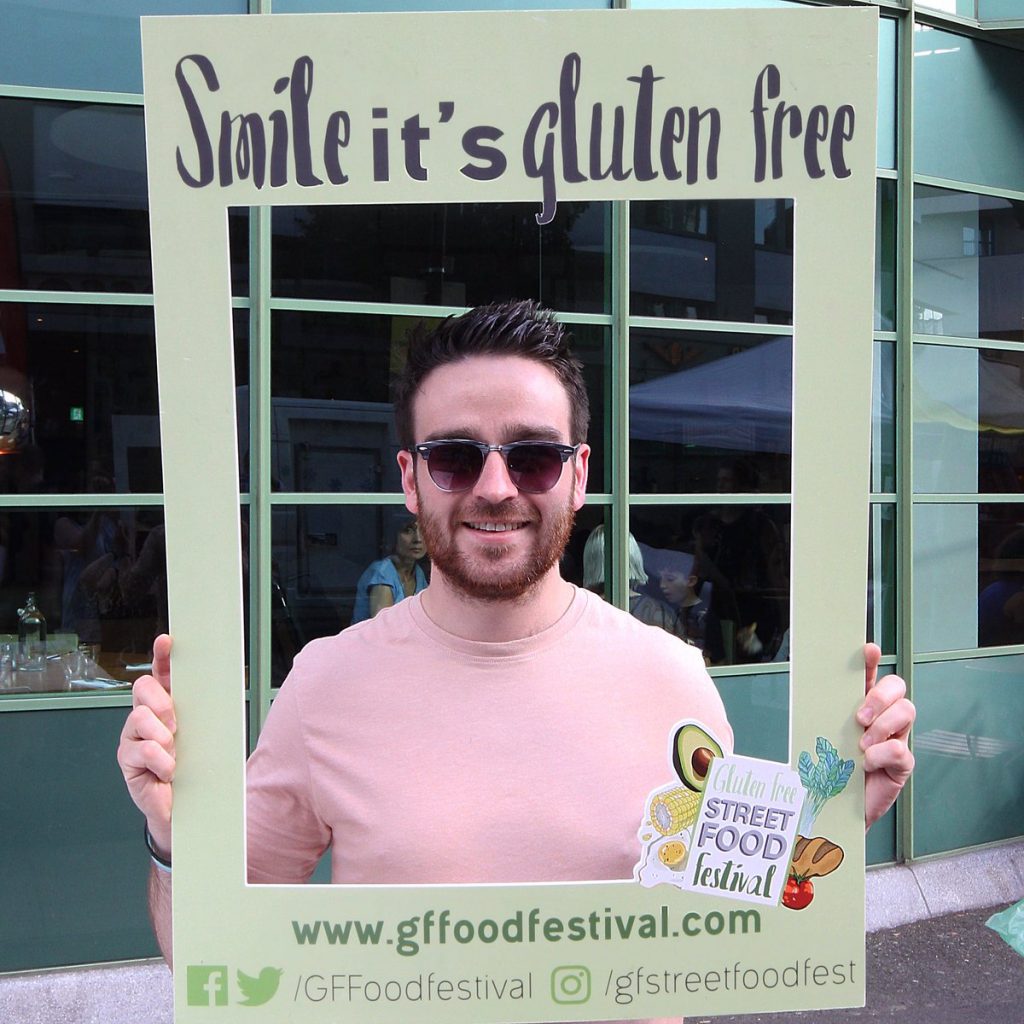
The Gluten Free Street Food Festival that I co-founded and have run for 5 years now. As Camden Market’s most successful series of events ever, they work because the content and the audience need each other. Not because I’m coeliac and wanted somewhere nice to eat. I don’t even follow a gluten free diet! But I saw the opportunity to bring these two elements together and viola!

Or,

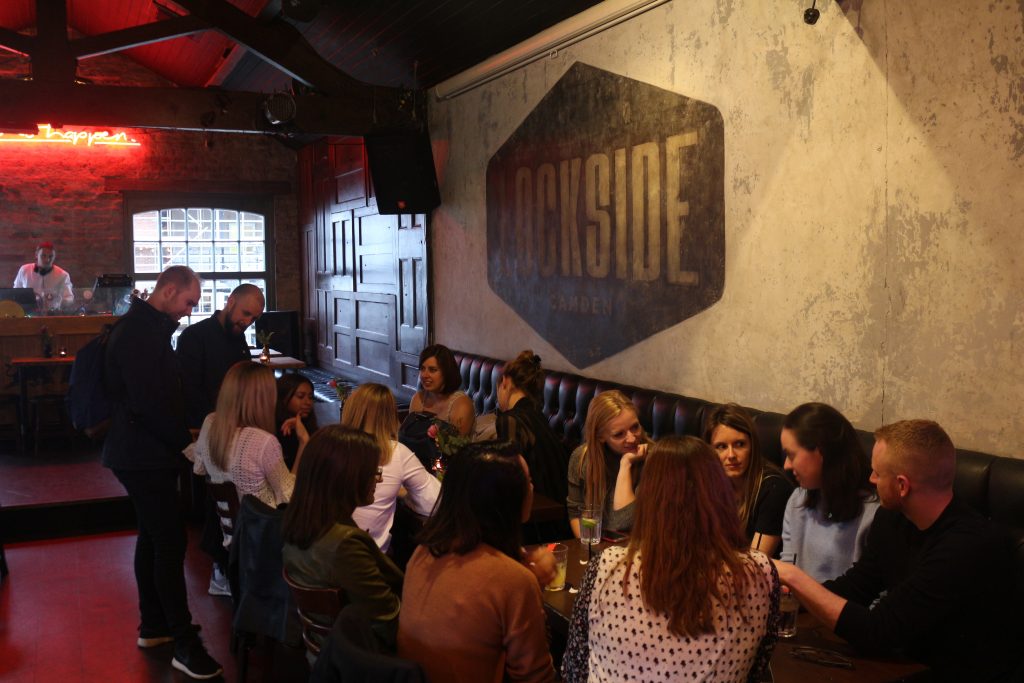
The Camden Get Down, one of the regular nights that I promote as part of the wider marketing remit for Lockside Camden. If the feedback we get on Facebook is anything to go by people seem to be having a good time!!

Working with bars, restaurants and street food vendors.

I’ve written previously about live events and how we integrate digital (read the post on Live content marketing) so I won’t go on about it again here. But what I thought would be worth sharing is about marketing F&B businesses and the challenges I face with my clients and the industry faces in general.

I work with bars, restaurants and street food vendors and as you can imagine, each of these entities has its own foibles and challenges. And the challenges are big.

But let’s start with the pros before we get too down on the cons. Working with F&B businesses, if you’re a massive foodie like myself, is a dream. And I recognise that I have been particularly lucky to only have worked with extremely high quality offerings. It’s impossible to not get ‘hands on’ working with these clients. I’ve set company-wide strategies and helped clear glasses. I have launched restaurants and sat in on wine tastings (I lied, THAT’S my dream job!). I’ve sampled new menus and designed new websites. I will lug boxes with the best of them. It is a very involved relationship, you must get an insider understanding of so many aspects of the business and the industry to be able to market it effectively. I’ve worked in seasonal business before but nothing compares to the immediacy of bars and restaurants. You are on call all the time. And as some of my clients are open until 3am, it really is almost a 24/7 job, particularly when it comes to social media.

No day, week or month is truly predictable and the peaks and troughs of trading are sharp and extreme. You can go from having the best week of the year to the worst in a very short space of time, so being able to adapt and react quickly are essential skills if you want to succeed.

You have to be able to pull in a huge range of skills, which is fortunate for me. Working out a customer journey and all the associated touch points, particularly for the busy independent London venues I work with, is almost impossible. Plus, typically, these sorts of businesses are not marketing-centric, so you are often fighting against ingrained processes, systems and infrastructure. At DVO, we are massive advocates of a test and refine methodology. With venues, this is basically the entire marketing model. Trying to plan and forecast is incredibly hard, so you work in the here and now and make sure you are fluid enough to be able to deal with the constant flux.

In London especially, trends, what’s ‘cool’, the latest and greatest and the next ‘BIG THING’ changes in the blink of an eye. It can be overwhelming trying to keep track of it all. My advice? To a certain extent, don’t bother. It’s easy to get dragged into trying to force your perfectly great square peg of a venue into the completely unrelated round hole of a trend. Instead, focus on your customer. Where else are they going? What interests them? What do they want? So, if you’re a beer and burger kind of a place, don’t get too bogged down in the vegan trend. Focus on what’s happening in your market sector and if there are ways you can successfully take advantage of a trend without undermining your fundamental offer, give it a go. If you can’t, don’t.

Beware the ‘if I build it, they will come’ operator. As I’ve mentioned, running and working in venues is obscenely hectic, with long hours and huge amounts of stress. The support I give my clients reaches well outside of a normal marketing remit, and to be honest it’s one of the things I love about my job. But I’ve encountered many owners and managers who, with little or no understanding or appreciation of marketing, believe that the fact they have a bar, beer and a barman, is all they need to do to get customers.

My top tips

Here’s some of my best tips, also grab a look at the marketing services for street food, bars and restaurants for the kind of support I provide and give me a shout if you want some advice. I’m all ears.

Know your audience.

marketing for bars, restaurants and street food

It’s crucial to really understand your target market. Especially in a crowded city like London with a huge amount of competition.

Pay attention to your brand.

Set the tone for your brand, visual, verbal, personality, values. You create unique food, drinks and events so take this philosophy straight into your marketing. It’ll help you to stand out and build your unique position in the market place. Here’s some tips we pulled together on Start-Up branding you might find useful if you’re struggling here. In fact this is one of the key areas where it’s worth getting outside help, someone who knows how to structure a brand and is objective enough to see the truth that exists. That’s very hard for owners and lots of valuable time can be wasted wrangling with brand.

Be in front of your audience in the right places.

That means social and mobile. In a fast moving market like London people don’t tend to pop home and get their laptop out when they want a bite to eat after drinks! Mobile focused social content and a strong search presence are key traffic drivers in this space. Smart use of Instagram is a real winner alongside Facebook and Twitter. Instagram’s focus on images is gold for restaurants and street food, the material is their it just needs a platform.

Focus on building your Instagram audience.

Once you’re over a certain threshold of followers you get access to features like the addition of links to stories. This is important as it sends users to a place where you can give them additional content or get sign-ups for a newsletter that contains regular offers. Or quickly promote a flash “happy hour”. Understanding these channels and making them work (that means getting a return) is always a key focus of mine.

Build an email list.

Email converts much better than all the social channels. Add value to the sign-up, exclusive offers, vouchers for freebies, competitions, run a masterclass on how to create your signature cocktails, burrito, [insert what you do here]!

Set clear goals.

If you’re a restaurant and you need bookings make this the focus of your work. If you need footfall to a street food stall and you want to drive awareness of where you’ll be, market yourself accordingly. If you have a new signature cocktail ditto. In short set clear goals that relate directly to a business goal. You can the structure your marketing to meet those goals, at least that’s what I do for my clients.

This list isn’t exhaustive so I’ll be following this up with a post for marketing bars, restaurants and street food on social media. Focusing on the specifics of each channel, Instagram, Twitter and Facebook. I’ll also be putting this into context as part of your wider marketing strategy and will share some of the tricks I’ve learnt and put into practice for DVO’s clients.

Sign-up to the newsletter to make sure you see our social media tips. You’ll see a nice pop up on the right or drop your details in the sign up form on this page.

Live content marketing, bringing the real world online.

We’ve been working hard behind the scenes to develop a live content marketing strategy that’s accessible for the majority of brands, not just the few.

Live content marketing the next step in truly integrated content marketing.

Traditionally live events have been something only really accessible to the big budget brands. If you wanted to do a product launch or do some sort of live activation, that was any good, then you either had to put something on yourself or sponsor something like a festival or similar.

The main problem here is obviously expense and in the case of large scale events, if your product doesn’t have mass appeal, then you’ll likely only be talking to a fraction of the audience. So great if you can afford it and want the large scale brand exposure but what about the other end of the spectrum?

We’ve been talking a lot about user generated content (UGC) of late and how important it is for brands to deliver authenticity in their content and communications. So this got us thinking. We wanted to figure out a way we could capture UGC and the stories, images and video that we could integrate into our digital content strategy. Content that would act as both hero content but also fuel enough authentic content production that would take us a world away from the trap of generic content production, perpetuating the sea of noise. Not something we make a habit of falling into I should add!

So we created Live content marketing.

An integrated approach to content marketing that uses live scenarios intertwined with digital to create truly authentic content, strong on UGC with digital distribution.

How’s it different to running a live event?

It’s hard to find niche events that are truly authentic and get the most out of them if you’re a brand. So we’ve done that for you. In Live content marketing we work as curators to build the live and digital elements of the content strategy together, using the best of both to create stunning live content marketing that will fuel your digital channels and truly engage people, motivating them to buy your products and services.

How is this any cheaper than running a live event?

DVO are the curators of the live content so we bring together an experience based on a niche vertical that a small number of brands can tap into. It’s not your event and that’s important because it gives it the authenticity. It’s a bit like when people say “don’t sell in your online content” because it turns people off. Same principle really, the live events have their own distinct brand you’re just a part of the experience.

Why does this work in digital?

Live events should be a catalyst for a ton of digital content but very often opportunities are lost. Ever thought about putting a Go-Pro on your guys and girls giving out samples, taking images and shooting video? Logistically it’s a lot to take care of , by centralising this we curate and create all the content and then distribute this accordingly to the brand partners to be used digitally, in blogs, advertising etc etc

Why is UGC so powerful?

Because people trust other people more than they trust your brand. In fact in most studies it’s nearly twice as much. It’s not that they don’t like you, they do, it’s just human nature. But how do you get your hands on authentic content if you fall outside the obvious industry sectors like travel where it’s quite easy to find content on social media about destinations and holidays. Well you need to find a way to stimulate the content and then capture it.

Sure you can do that online, but whats better than handing someone your product to sample and recording their feedback live to be distributed online.

Nothing!


It’s early days for us developing this concept, our second event is taking place in July and we’re keen to speak to anyone in the Gluten free space who likes trying things out. Contact us for more details, here.

Achieving Content Marketing Nirvana: A Lesson From The Best In The Business

This week we discuss what a true content marketing leader is doing and how it’s strategy has evolved to embrace a content approach aligned to the reality of todays consumer

As a content marketing agency it’s our job to keep tabs on what the best in the business are doing. There are a host of brands doing great things but Coca-Cola can be considered a true content marketing leader. You may have read recently that Coca-Cola has suspended its brand advertising in the Philippines so that it can donate its entire ad budget to typhoon relief efforts. It’s a great cause and already the company has donated over $2.5 million in cash and in-kind contributions, but people have been quick to question whether suspending advertising is a marketing ploy in itself.

In my opinion and without detracting from any of the good Coca-Cola is clearly doing, this is undoubtedly a marketing win for the company. Why? Because the content created and awareness raised around generosity slots perfectly into the company’s content focused marketing strategy. Continue reading